
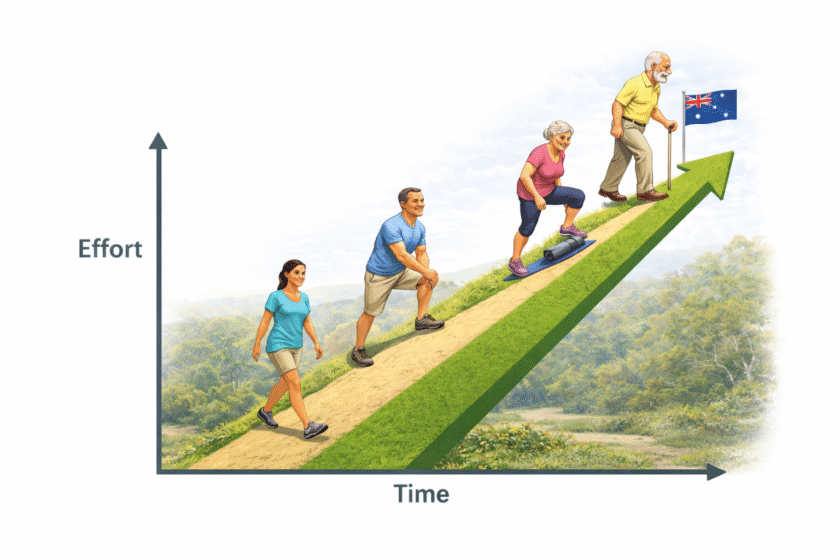
Why Maintaining Strength Requires MORE Effort as You Age
At first glance, it may seem that staying active should become easier with routine and experience.
However, the reality is that as we age, our bodies require more effort and more structured training simply to maintain the same level of strength, mobility and physical capacity.
Activities that once maintained your quality of level functionally in your 20s may no longer be enough in your 40s, 50s and beyond. Understanding this shift is key to staying active, independent and injury-free across the lifespan.
Strength Naturally Declines Over Time
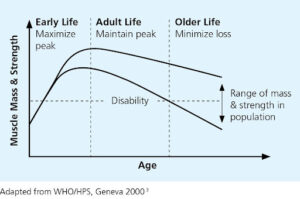
Age-related loss of muscle mass and strength — known as sarcopenia — is a well-documented physiological process.
Research shows:
- Strength declines from around 30–40 years of age
- Decline accelerates after 50
- Losses of 1.5–5% per year can occur in older adults (Keller et al, 2014)
These changes are strongly associated with reduced function, increased falls risk and decreased independence.
Additionally, reductions in muscle mass, strength and power are strongly linked to:
- Reduced physical performance
- Increased falls risk
- Decline in quality of life (Trombetti et al, 2015)
These changes are not just cosmetic — they directly impact independence and daily function.
It’s Never Too Late to Improve Strength
One of the most important findings in research is that:
👉 Strength can be improved at any age
Even in older adults:
- Muscle strength can increase
- Functional capacity can improve
- Risk of falls can be reduced
The key factor is consistent, progressive training.
Range of Motion and Flexibility Also Decline
Ageing does not only affect muscle — it also impacts joint mobility and movement efficiency.
Research shows that:
- Joint range of motion decreases progressively with age
- Changes are commonly seen in the spine, hips and ankles
- Reduced mobility contributes to altered movement patterns and increased joint stress
At the same time, connective tissue (including fascia) undergoes structural changes.
With ageing:
- Tissue hydration decreases
- Collagen structure becomes more rigid
- Elasticity reduces
- Tissue stiffness increases
These changes impair force transmission and movement efficiency across the body
This explains why many people feel “stiffer” as they age — and why mobility training becomes just as important as strength training.
(Zullo et al, 2020)
Maintenance Requires Intentional Effort
One of the most important concepts is that maintenance is no longer passive.
In younger individuals:
- General activity is often enough to maintain strength
With ageing:
- Muscle loss occurs even in active individuals
- Strength declines faster than muscle size (reduced muscle quality)
- Neuromuscular efficiency and power output decrease
This means maintaining strength requires:
-
- Progressive overload
- Targeted resistance training
- Consistency over time
Importantly, research shows that strength training interventions can significantly improve or maintain physical function in older adults, even later in life
(Halma et al, 2025)
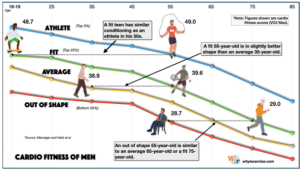
National Physical Activity Guidelines Across the Lifespan
Australian guidelines reinforce the importance of structured activity.
For adults 18–64 years:
- 2.5–5 hours of moderate activity per week
- Strength training at least 2 days per week
For adults 65+ years:
-
- Daily activity
- Strength, balance and functional training
- Focus on maintaining independence and reducing falls risk
These recommendations reflect strong evidence that strength training is essential — not optional — for healthy ageing.
(Australian Government, Department of Health, Disability and Ageing, 2026)
Why Strength and Mobility Matter for Everyday Life
Loss of strength and mobility directly impacts function.
Research links these changes to:
- Reduced walking capacity
- Difficulty with stairs and transfers
- Increased falls risk
- Reduced confidence in movement
Maintaining both strength and range of motion supports:
• Independence
• Efficiency of movement
• Injury prevention
(Trombetti et al, 2015)
Strength Training Supports Long-Term Health
Strength training is also strongly linked to broader health outcomes.
Evidence shows it can:
- Improve metabolic health
- Maintain muscle mass and function
- Reduce chronic disease risk
- Improve overall physical performance
Importantly, muscle decline is not inevitable — it is highly modifiable with the right stimulus.
(Australian Government, Department of Health, Disability and Ageing, 2026)
Support for Older Adults at Pontifex Physiotherapy
At Pontifex Physiotherapy, we offer targeted services to support these changes.
Our Senior Screening assessments identify early changes in:
• Strength
• Range of motion
• Balance and mobility
Following this, our Senior Strength and Conditioning programs are designed to:
- Build strength safely
• Improve mobility and flexibility
• Increase confidence in movement
• Maintain independence
These programs are structured and progressive — aligning with current evidence on healthy ageing.
Take Home Message
Maintaining strength, mobility and flexibility is not automatic.
Research clearly shows that:
- Physical capacity declines with age
- Strength and mobility both contribute to function
- More effort is required over time to maintain the same level
However, with the right approach:
These changes can be slowed, managed and even reversed.
If you would like support developing a structured program, speak to our team about our Senior Screening and Strength & Conditioning services.
Halma, M. et al. (2025a) ‘Reversing Decline in Aging Muscles: Expected Trends, Impacts and Remedies’, Journal of Functional Morphology and Kinesiology, 10(1), pp. 29–29. Available at: https://doi.org/10.3390/jfmk10010029.
Halma, M. et al. (2025b) ‘Reversing Decline in Aging Muscles: Expected Trends, Impacts and Remedies’, Journal of Functional Morphology and Kinesiology, 10(1), pp. 29–29. Available at: https://doi.org/10.3390/jfmk10010029.
Health, (2026a) Recommendations for older adults (65 years and over), Australian Government Department of Health, Disability and Ageing. Available at: https://www.health.gov.au/topics/physical-activity/24-hour-movement-guidelines-for-all-australians/recommendations-for-older-adults-65-years-and-over?language=en.
Health, (2026b) Recommendations for older adults (65 years and over), Australian Government Department of Health, Disability and Ageing. Available at: https://www.health.gov.au/topics/physical-activity/24-hour-movement-guidelines-for-all-australians/recommendations-for-older-adults-65-years-and-over?language=en.
Keller, K. and Engelhardt, M. (2014a) ‘Strength and muscle mass loss with aging process. Age and strength loss’, Muscles, Ligaments and Tendons Journal, 3(4), p. 346. Available at: https://pmc.ncbi.nlm.nih.gov/articles/PMC3940510/?utm_source=chatgpt.com.
Keller, K. and Engelhardt, M. (2014b) ‘Strength and muscle mass loss with aging process. Age and strength loss’, Muscles, Ligaments and Tendons Journal, 3(4), p. 346. Available at: https://pmc.ncbi.nlm.nih.gov/articles/PMC3940510/?utm_source=chatgpt.com.
Trombetti, A. et al. (2015a) ‘Age-associated declines in muscle mass, strength, power, and physical performance: impact on fear of falling and quality of life’, Osteoporosis International, 27(2), pp. 463–471. Available at: https://doi.org/10.1007/s00198-015-3236-5.
Trombetti, A. et al. (2015b) ‘Age-associated declines in muscle mass, strength, power, and physical performance: impact on fear of falling and quality of life’, Osteoporosis International, 27(2), pp. 463–471. Available at: https://doi.org/10.1007/s00198-015-3236-5.
Trombetti, A. et al. (2015c) ‘Age-associated declines in muscle mass, strength, power, and physical performance: impact on fear of falling and quality of life’, Osteoporosis International, 27(2), pp. 463–471. Available at: https://doi.org/10.1007/s00198-015-3236-5.
Trombetti, A. et al. (2015d) ‘Age-associated declines in muscle mass, strength, power, and physical performance: impact on fear of falling and quality of life’, Osteoporosis International, 27(2), pp. 463–471. Available at: https://doi.org/10.1007/s00198-015-3236-5.
Zullo, A. et al. (2020a) ‘Structural and Functional Changes in the Coupling of Fascial Tissue, Skeletal Muscle, and Nerves During Aging’, Frontiers in Physiology, 11. Available at: https://doi.org/10.3389/fphys.2020.00592.
Zullo, A. et al. (2020b) ‘Structural and Functional Changes in the Coupling of Fascial Tissue, Skeletal Muscle, and Nerves During Aging’, Frontiers in Physiology, 11. Available at: https://doi.org/10.3389/fphys.2020.00592.




🌎 Happy World Physiotherapy Day! 🩵
Today we’re celebrating physiotherapy and the difference it can make at every stage of life.
From recovering from an injury and returning to sport, to building strength, managing pain and staying active as we age — physiotherapy is about helping people move better, feel stronger and get back to doing what they love.
We’re incredibly proud of our team at Pontifex Physiotherapy and the care, knowledge and passion we bring to every patient.
We genuinely love what we do as physios — getting to work with people, support their recovery, celebrate their progress and help them achieve the things that matter most to them.
A big thank you to all of our patients for trusting us with your health, recovery and goals. 🩵
Happy World Physiotherapy Day! ... See MoreSee Less
1 CommentsComment on Facebook
Thanks to all of our wonderful patients, we are once again finalists in the Sutherland Shire local business awards. 💙
We are so grateful for your continued support and trust in our team! 💙 ... See MoreSee Less
0 CommentsComment on Facebook
TODAY IS THE FINAL DAY TO VOTE IN THE SUTHERLAND SHIRE BUSINESS AWARDS!!
Please click the link to vote for us!
thebusinessawards.com.au/40681/pontifex-physiotherapy-and-performance ... See MoreSee Less
0 CommentsComment on Facebook